Bronnen · 10
Informatie-integriteit: verificatie van herkomst, context en transformaties
Een procedure voor het kwalificeren van een document, afbeelding of video voordat deze wordt geciteerd, gedeeld of gebruikt in een besluit.
Bijgewerkt · 8 min

Wat deze handleiding helpt bereiken
- Zoek de vroegst toegankelijke versie
- Scheid een authentiek bestand van een vals onderschrift
- Documenteer transformaties
- Corrigeer zonder het spoor te wissen
Snelle controle
- Wie heeft het bestand gepubliceerd en waar hebben ze het vandaan?
- Bestaat er een eerdere versie?
- Zijn locatie en licht compatibel?
- Zijn metadata consistent, maar worden ze niet als voldoende beschouwd?
- Welke inhoud is afhankelijk van dit bewijs?
Stapsgewijze methode
- 1
Bewaar het item
Bewaar de URL, toegangsdatum, ontvangen bestand, zichtbare context en een hash waar wettelijk toegestaan. Werk met een kopie en registreer elke conversie.
Resultaat: logboekvermelding en hash.
- 2
Herkomst traceren
Zoek naar de vroegste publicatie, de beweerde maker, tussenliggende doorgeefluiken en eventuele bijgesneden of opnieuw gecomprimeerde versies.
Resultaat: herkomstketen.
- 3
Controleer inhoud en context
Vergelijk terrein, gebouwen, weer, schaduwen, taal, chronologie en bekende gebeurtenissen. Een authentieke afbeelding kan worden hergebruikt met een valse plaats of datum.
Resultaat: bevestigde en verworpen hypotheses.
- 4
Inspecteer metadata
Gebruik EXIF, codering, afmetingen en geschiedenis als aanwijzingen. Hun aanwezigheid of afwezigheid bewijst op zichzelf nooit de authenticiteit.
Resultaat: geïnterpreteerd technisch verslag.
- 5
Onafhankelijk bevestigen
Zoek een primaire bron, een andere invalshoek, een officieel document of een onafhankelijke getuige. Identificeer herhalingen die allemaal afhankelijk zijn van hetzelfde bestand.
Resultaat: corroboratiematrix.
- 6
Publiceren en corrigeren
Vermeld de betrouwbaarheid, beperkingen, methode en bron. Als de conclusie verandert, werk dan de gekoppelde pagina's bij en bewaar een gedateerde correctienotitie.
Resultaat: redactionele beslissing en correctieregister.
Begrijpen, berekenen en beslissen
Echte foto: bestand, bijschrift en paginadatum onderscheiden
De NASA-pagina voor deze „Earthrise”-afbeelding noemt Lunar Orbiter 1 en vermeldt NASA als bron. De paginadatum bewijst geen opnamedatum. Ook de titel alleen identificeert geen missie.
Controleer een concrete bewering op de institutionele bronpagina. Bewaar de verwijzing en noteer wijzigingen voor weergave. Een hash identificeert een kopie, maar bewijst niet dat de scène of interpretatie waar is.
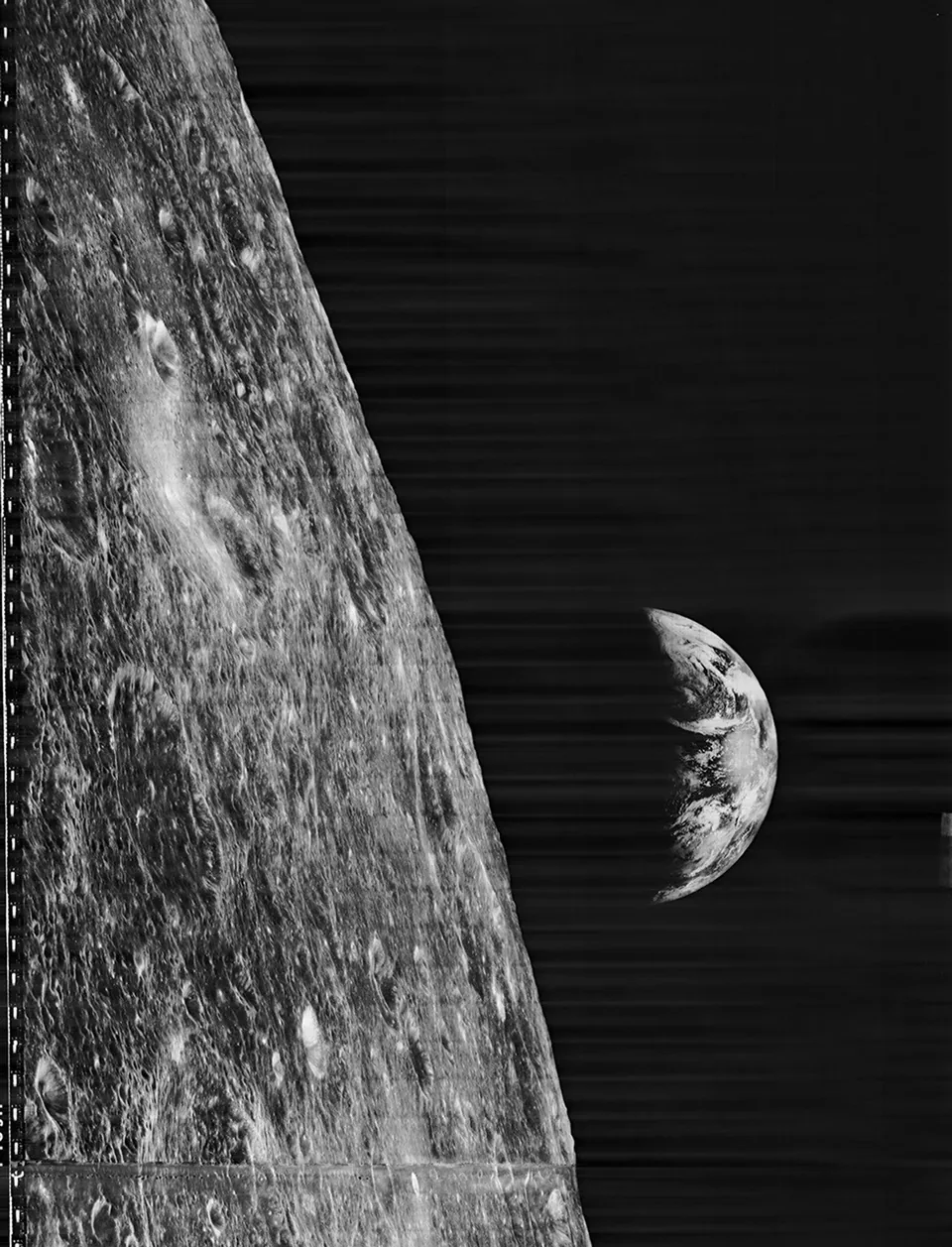
Kengetallen en bewijs
| Kengetal | Betekenis | Benodigd bewijs |
|---|---|---|
| Bestand | De onderzochte kopie | Verwijzing, raadpleegdatum en hash |
| Bijschrift | Door de bron gepubliceerde toeschrijving | Missie en bronvermelding vergelijken met de pagina |
| Rechten | Hergebruikvoorwaarden staan los van authenticiteit | NASA-richtlijnen, bronvermelding en formaatwijziging |
Fictief uitgewerkt voorbeeld
Illustratieve situatie
Een virale afbeelding beweert een recente gebeurtenis te tonen. Het team zoekt naar de vroegste publicatie, vergelijkt zichtbare locaties en leest de herkomstmetadata indien aanwezig.
Beslissing en verwachte bewijs
De notitie maakt onderscheid tussen wat technische herkomstinformatie aantoont, wat onafhankelijke bronnen bevestigen en wat nog niet kan worden geconcludeerd.
Managementindicatoren
| Indicator | Wat het meet | Eerste actie |
|---|---|---|
| Herkomst | Items gekoppeld aan een gedocumenteerde oorsprong | Behandel doorslaggevend bewijs zonder eerst een bron te vermelden |
| Bevestiging | Conclusies ondersteund door onafhankelijke aanwijzingen | Verwijder circulaire herhaling |
| Correctievertraging | Tijd tussen het ontdekken van een fout en het bijwerken van de inhoud | Onderhoud de lijst met afhankelijke pagina's |
| Zichtbare onbekenden | Belangrijke beperkingen expliciet vermeld | Voorkom dat een hypothese een feit wordt |
Veelvoorkomende fouten
- Ontbrekende EXIF-gegevens behandelen als bewijs van vervalsing
- Stoppen na een lege omgekeerde zoekopdracht
- Herpublicaties meetellen als onafhankelijke bronnen
- Eén pagina corrigeren, maar niet de kopieën ervan
Veelgestelde vragen
Bewijzen metadata de echtheid van een afbeelding?
Nee. Ze kunnen worden verwijderd, gewijzigd of overgenomen van een apparaat. Bevestig ze met inhoud, context en herkomst.
Hoe moet synthetische content worden behandeld?
Zoek naar beschikbare herkomstinformatie, onderzoek de consistentie en context en beoordeel vervolgens de waarheid van de bijbehorende bewering.
Moet een fout worden verwijderd?
Corrigeer de content en de verspreiding ervan duidelijk. Wanneer de content lezers al heeft beïnvloed, is een gedateerde notitie een betere verklaring voor de wijziging dan stilletjes verdwijnen.
Referenties: gegevens, gebruik en grenzen
Documentatie geraadpleegd op .
De uitgebreide toelichtingen zijn in deze editie beschikbaar in het Engels.
| Bron en doel | Gecontroleerde gegevens of maatstaf | Praktisch gebruik | Te behouden beperking |
|---|---|---|---|
| FIRST · Traffic Light Protocol Indicate who may receive redistributed information. |
TLP 2.0 uses RED, AMBER, GREEN and CLEAR; AMBER+STRICT restricts sharing to the recipient organisation. Labels must not be translated. | Keep the marking with the information and check recipients before forwarding. Ask the source to clarify any ambiguity. | TLP is neither a formal classification nor a reuse licence. It does not guarantee content accuracy. |
| C2PA · Content Credentials Describe and verify certain content provenance information. |
C2PA specification 2.4 defines manifests, assertions and cryptographic binding mechanisms associated with media. | Examine what the manifest asserts, who signed it and whether validation succeeds. Test preservation after transformations and distribution. | Validated provenance does not establish the truth of a scene. Absence of a manifest does not demonstrate a fake. |
Mediaherkomst en C2PA-validatie
De uitgebreide toelichtingen zijn in deze editie beschikbaar in het Engels.
A provenance report combines findings with different scopes. Signature, credential trust, content binding and scene context are separate assurances. Retain the exact asset and full report before summarising a result.
References use C2PA 2.4, dated April 2026 in its version history. This explorer explains twelve selected codes; it validates no file, retrieves no manifest and detects no AI-generated image. Cases are fictional and proposed checks are editorial guidance.
References consulted on .
Read twelve C2PA codes without overinterpreting them
The groups below are those used by the specification: success, informational and failure. A success code describes its particular check rather than replacing full validation. Missing information and a failed check cannot be reduced to a fake label.
| Code and group in C2PA 2.4 | Reported finding | Proposed follow-up | Conclusion to avoid |
|---|---|---|---|
claimSignature.validatedSuccess · success | The claim signature validated. | Also inspect trust, validity period and binding to the relevant asset. | The whole scene is true or every validation check is complete. |
signingCredential.trustedSuccess · success | The validator recognises the signing credential as trusted. | Record the trust list, its version and applied policy. | A signer’s name alone confirms the depicted event. |
timeStamp.validatedSuccess · success | The time-stamp token passes the checks described in the specification. | Distinguish it from capture time and inspect trust in the time-stamping authority. | The attested time necessarily dates the photographed scene. |
assertion.dataHash.matchSuccess · success | The data-hash binding matches within the checked scope. | Inspect the assertion, excluded ranges and any other applicable bindings. | Every byte and every metadata field is covered without exception. |
signingCredential.ocsp.inaccessibleInformation · informational | An online OCSP check was attempted without a response. | Retain network conditions and distinguish no response from a returned status. | The certificate is revoked, or certainly not revoked. |
signingCredential.ocsp.unknownInformation · informational | The OCSP response reports unknown for the signing credential. | Read the report and the policy used to handle that status. | Unknown means good or revoked. |
ingredient.unknownProvenanceInformation · informational | The relevant ingredient has no C2PA manifest. | Identify that ingredient and what its history actually makes available. | All ingredients were verified or that ingredient must be fake. |
assertion.dataHash.additionalExclusionsPresentInformation · informational | The binding excludes ranges beyond the C2PA Manifest Store. | Identify the excluded regions and their relevance to the claim being examined. | A hash success automatically protects excluded metadata. |
claimSignature.mismatchFailure · failure | Claim signature verification fails. | Retain asset, manifest and report; compare with the available source copy. | The cause of failure or somebody’s intent is already established. |
signingCredential.untrustedFailure · failure | The credential appears on none of the validator’s applicable trust lists. | Check policy and lists; distinguish this from a mathematically incorrect signature. | The file must be fabricated or its signature must be mathematically invalid. |
assertion.dataHash.mismatchFailure · failure | An asset byte range does not match the hash declared in the assertion. | Identify the checked copy and its transformations before explaining the difference. | Every difference establishes intentional falsification of the scene. |
signingCredential.ocsp.revokedFailure · failure | The OCSP response indicates revocation under the applied check. | Read the temporal evidence and validation procedure behind the result. | A summary detached from its date and report establishes the status of every copy. |
No code matches the filters.
Four version details useful to editorial and technical teams
- Published version
- The examples above follow C2PA 2.4, published in April 2026. Version 2.5, published in October 2026, expands support for asset formats and live media. Record your validator version and check the status-code table for the corresponding edition before interpreting a result.
- specVersion
- In this version the recommended field belongs in claim_generator_info. It is informational; validators should not change logic solely because of its value.
- crJSON
- This JSON-LD representation is a derived view of C2PA data for reporting and interoperability. It is not independently verifiable or a validation input format.
- c2pa.ai-disclosure
- The assertion carries an AI transparency declaration. It is not a universal detector, and its absence does not prove human origin.
Six fictional situations for a publication decision
| Fictional situation | Concrete check | Decision proportionate to evidence |
|---|---|---|
| A signed photo receives a new caption | Match the asset and report against the scene, date and location claimed by the new caption. | Describe checked provenance and leave the event attribution unresolved if uncorroborated. |
| A resized variant no longer matches the old binding | Compare original, transformation tool, distributed variant and manifest associated with each. | Handle the validation break without inferring malicious manipulation from the hash code alone. |
| Two validators do not trust the same signer | Record versions, trust lists and policy, then compare other findings. | Explain the trust-policy difference rather than treating it as contradictory truths about the scene. |
| A screenshot no longer presents a Content Credential | Seek the earlier asset and document the known copy chain. | Retain the screenshot’s status and incomplete history; an absent manifest does not establish a fake. |
| A binding success accompanies excluded metadata | Identify excluded fields or ranges and caption claims depending on them. | Limit the conclusion to covered data and verify decisive fields another way. |
| A supplier sends only a crJSON report | Request the asset and provenance data needed for verification, plus tool version and policy. | Examine the report without claiming to have repeated cryptographic validation. |
Retain a usable verification record
- Exact object
- Examined asset or stream, known origin, copy and transformations.
- Tool and policy
- Validator, version, configuration and relevant trust lists.
- Complete findings
- Codes, relevant object, explanations and time evidence; keep inconclusive information as well.
- Examined claim
- Exact statement about location, date, creator or AI use and its source.
- Editorial decision
- What is established, what is missing and what could change the conclusion.
Examine information origins and repetitions →
Primary sources and limits of this reader
This is not an exhaustive C2PA code inventory. Full procedures, formats and trust policies remain those of the specification and your validator. Diagrams, cases and records are CIE teaching proposals.
- C2PA · Content Credentials Technical Specification 2.4 · 2.4 · April 2026 ·
§5.3.1; §14.3; §15.2; §15.7–15.12 - C2PA · Content Credentials Technical Specification 2.5 · 2.5 · October 2026 ·
Appendix D and Appendix F.1 - C2PA · Content Credentials Explainer · 2.4
§2; §7.2–7.4 - C2PA · Security Considerations · 2.4
§2.2–2.6; §4; §5
STIX-indicatoren en TLP-deling
De uitgebreide toelichtingen zijn in deze editie beschikbaar in het Engels.
Check TLP scope before publishing an excerpt
A traceable note does not by itself grant permission to redistribute it. TLP markings, additional restrictions and intended recipients must accompany a redaction or publication decision.
- AMBER+STRICT limits sharing to the organisation; AMBER’s scope for protecting clients does not apply by default.
- GREEN excludes public channels; CLEAR does not remove copyright rules or separate restrictions.
- Check the marking of each quoted field and obtain explicit source permission if the intended sharing exceeds the received scope.
Read the STIX, observations and TLP sharing reference →
Sources checked on · FIRST · TLP 2.0
OSINT: bewijs bewaren
De uitgebreide toelichtingen zijn in deze editie beschikbaar in het Engels.
Claimed provenance and preservation answer different questions
An edit history or manifest does not replace collection context. Preservation connects objects actually received, copies created and documented handling actions.
- Separate binary integrity, source identity and an assertion’s truthfulness.
- Keep derivative versions with their own identifiers and references.
- Document missing material before reaching a trust conclusion.
See copy lineage and the eight preservation cases →
Sources reviewed on · NIST · Digital Evidence Preservation · NIST IR 8387 · Full report · NIST · SP 800-86 · NIST SP 800-86 · Full report · NIST · FIPS 180-4 · Secure Hash Standard
PDF: redactie en delen
De uitgebreide toelichtingen zijn in deze editie beschikbaar in het Engels.
A documented transformation still needs release review
Derivative lineage explains technical provenance; it does not prove all excluded information was removed. Visible, hidden and embedded surfaces still need checking.
- Separate pending marks, applied redaction and hidden-data sanitization.
- Check a positive control before interpreting a negative search.
- Bind the decision to the delivered version and its recipients.
See surfaces and the pre-sharing review matrix →
Sources reviewed on · Adobe · Redacting and sanitizing PDFs · Adobe · Redact sensitive content · Adobe · Sanitize PDFs · ICO · Avoid accidental breaches when redacting · ICO · Hidden information in documents · Microsoft · Document Inspector
Citatieketens en sociale monitoring
De uitgebreide toelichtingen zijn in deze editie beschikbaar in het Engels.
Separate origin, repost and corroboration
A capture or provenance signature may document a record without proving its claim. Before citing multiple publications, check whether they reference the same document.
- Keep the consulted version and its exact reference.
- Name missing citations instead of assuming their contents.
- Treat distinct documents as records to compare, without assuming independence.
Read the method and explore citation chains →
Government Communications · RESIST 3 · RESIST 3 · 2025 · consulted 2026-10-23
Government Communications · RESIST 3 quick reference · RESIST 3 · 2025 · consulted 2026-10-23
Officiële referenties
Referenties ondersteunen de methode. Pas controles aan uw context aan; ze zijn geen certificering. Originele referentietitels en brondocumenten kunnen in een andere taal zijn.
Bronnen geraadpleegd op .
- C2PA — Content Credentials Technical Specification 2.5
- UC Berkeley / OHCHR — Berkeley Protocol on Digital Open Source Investigations
- FIRST · Traffic Light Protocol
- C2PA · Content Credentials
- C2PA · Content Credentials Explainer
- C2PA · Security Considerations
- NIST · Digital Evidence Preservation
- NIST IR 8387 · Full report
- NIST · SP 800-86
- NIST SP 800-86 · Full report
- NIST · FIPS 180-4 · Secure Hash Standard
- Adobe · Redacting and sanitizing PDFs
- Adobe · Redact sensitive content
- Adobe · Sanitize PDFs
- ICO · Avoid accidental breaches when redacting
- ICO · Hidden information in documents
- Microsoft · Document Inspector
- Government Communications · RESIST 3
- Government Communications · RESIST 3 quick reference