Resources · 52
Portability: verify an exit from a digital supplier
Test export, reconstruction and continuity before contractual or technical dependencies make an exit impractical.
· 3 min
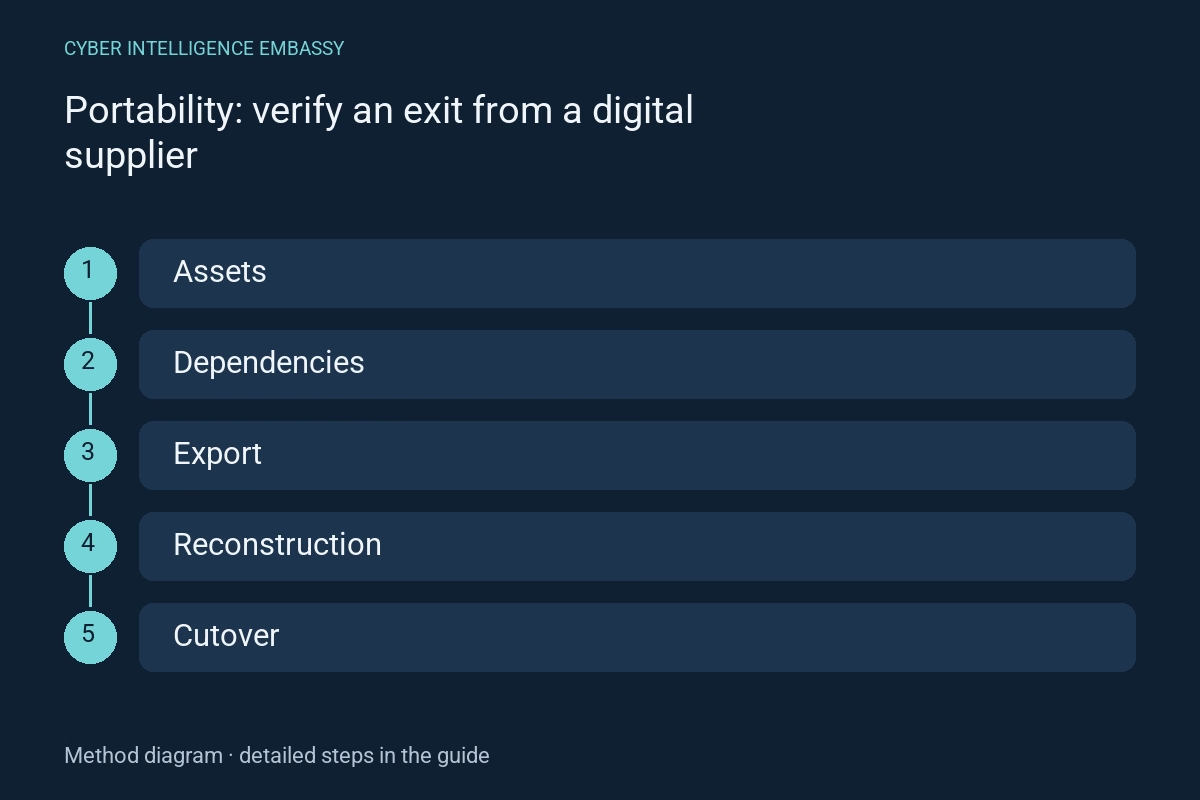
What this guide helps achieve
- Identify dependencies
- Test usable exports
- Estimate reconstruction
- Prepare a controlled cutover
Quick check
- What disappears without the supplier?
- Who can rebuild the service?
- Does export preserve relationships and rights?
- Which costs are absent from the initial quote?
- Can a failed cutover be reversed?
Step-by-step method
- 01
Define the service to preserve
List essential tasks and assets: data, attachments, configuration, automations and permissions. State what a replacement must deliver and what may temporarily operate in a degraded state.
Deliverable: exit scope.
- 02
Qualify dependency
Separate commercial commitment, proprietary formats, technical integration and skill shortages. GOV.UK recommends weighing service value against portability; avoiding every dependency is not always the best choice.
Deliverable: value and portability trade-off.
- 03
Test a representative export
Export authorised data including relationships, history and edge cases. Check format, encoding, identifiers and absence of secrets. Downloading a file does not prove it can be understood or imported.
Deliverable: export and completeness check.
- 04
Rebuild elsewhere
Import the sample in an isolated environment and execute an essential task. Record adaptations, metadata losses and manual steps. Include configuration and permissions, not just content.
Deliverable: replayed task and gaps.
- 05
Estimate and order the transition
Estimate extraction, transfer, parallel operation, training and support. Separate measured costs, quotes and assumptions. Set cutover order, change freeze and rollback if acceptance fails.
Deliverable: plan and cost assumptions.
- 06
Keep evidence current
Repeat after new integration or format changes. Check asset return and copy handling under the service’s applicable rules. An exit clause does not replace a technical demonstration.
Deliverable: schedule and exit dossier.
Reusable worksheet
Complete with your authorised observations. These fields are a working template, not observed results.
| Field | Information to record |
|---|---|
| Asset | Owner, volume and dependency |
| Export | Format, relationships, attachments and rights |
| Reconstruction | Tested task, result and gaps |
| Cutover | Costs, time, stop and rollback |
Worked example
Illustrative situation
Fictional example: a CRM exports contacts but omits attachment relationships.
Decision and expected evidence
Acceptance records the gap before cutover; extraction and attachment reconciliation are added rather than claiming readiness.
Distinguish the mechanisms
| Mechanism | Purpose | Check or limitation |
|---|---|---|
| Exit clause | Define commitments for review | Does not demonstrate technical continuity |
| Export | Retrieve assets | Check relationships and metadata |
| Tested reconstruction | Demonstrate use elsewhere | Document lost functions |
Management indicators
| Indicator | What it measures | First action |
|---|---|---|
| Exportable assets | Critical assets retrieved and readable | Address omissions |
| Rebuilt tasks | Journeys replayed outside the supplier | Fix residual dependencies |
| Transition effort | Observed or estimated time and cost | Separate measurement from assumptions |
Common pitfalls
- Confusing termination with continuity
- Checking exports only after commitment
- Forgetting attachments and permissions
- Claiming a certain cost without testing
Frequently asked questions
Should every dependency be rejected?
No. Dependencies can provide value. Record what you accept, exit costs and conditions that would change the decision.
Is a CSV enough?
Only if it covers necessary data and relationships with an understood schema and tested import.
When should exit be tested?
Before committing critical functions and after changes that increase dependency.
Official references
References consulted on 2 October 2026. The method and worksheet propose checks to adapt to your context; they do not constitute certification.
Continue exploring
Related analysis