Resources · 04
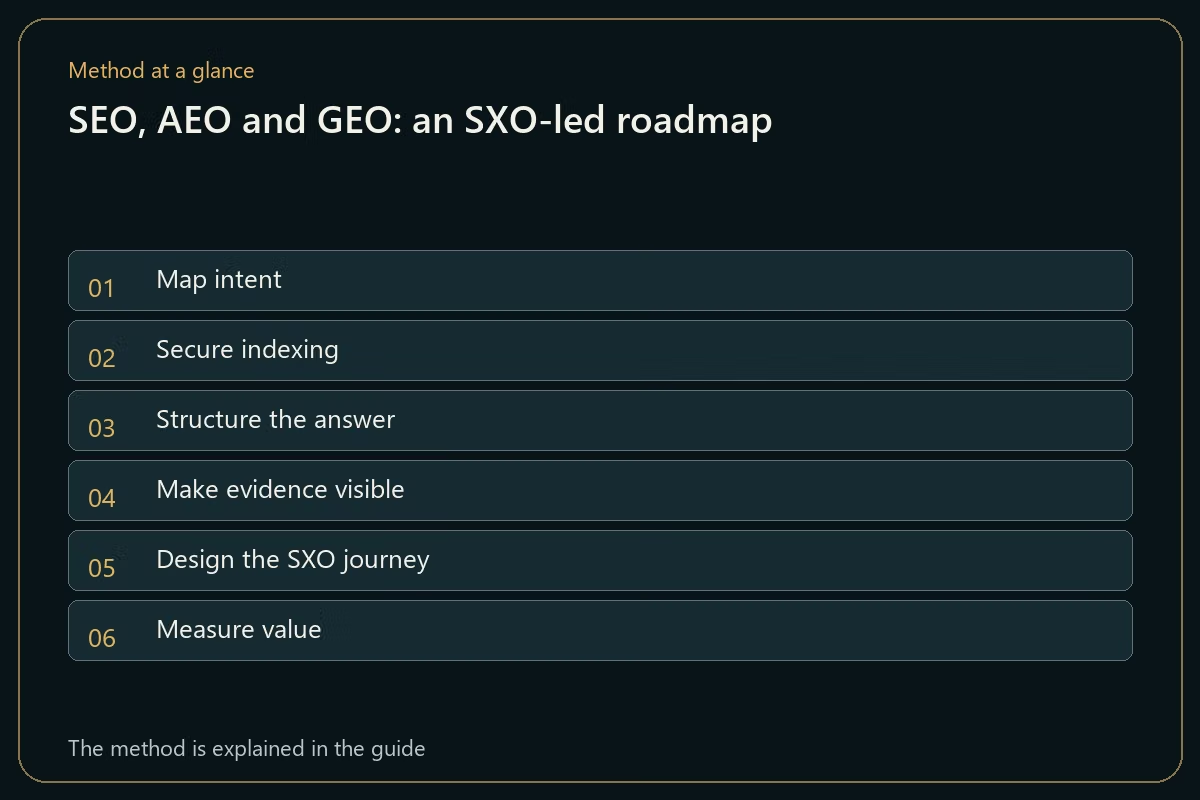
SEO, AEO and GEO: an SXO-led roadmap
Connect indexing, direct answers, citation readiness and conversion in one measurable content architecture.
· 3 min
What this guide helps achieve
- Avoid cannibalisation
- Answer quickly without losing depth
- Make expertise attributable and citable
- Connect every page to a useful action
Quick check
- Is there one primary page for each intent?
- Is the essential answer visible without friction?
- Is evidence dated and attributed?
- Do internal links follow the decision journey?
- Is conversion measured by entry page?
Step-by-step method
- 01
Map intent
Group questions, tasks and objections by real need. Assign one primary page to each intent and merge duplicates.
Deliverable: intent × page × action map.
- 02
Secure indexing
Review status codes, canonicals, robots, sitemaps, hreflang, rendering, depth and orphan pages before adding volume.
Deliverable: prioritised technical backlog.
- 03
Structure the answer
Lead with a concise answer, then method, examples, limitations and next steps. Use descriptive headings and readable tables.
Deliverable: editorial template.
- 04
Make evidence visible
Identify author or organisation, method, sources, update date, definitions and scope. Structured data must mirror visible content.
Deliverable: evidence checklist.
- 05
Design the SXO journey
Connect discovery, understanding, comparison, trust and action. Keep essential information and action immediate on mobile.
Deliverable: journey and internal link plan.
- 06
Measure value
Track indexing, queries, engagement, progression, conversion and qualified enquiries by intent group. Then improve, merge or remove.
Deliverable: performance dashboard.
Your acceptance workbook
Record observations against this guide’s criteria. A record is not certification.
The workbook does not save automatically. Export before leaving.
Filters do not limit exports. Actions include issues and unreviewed criteria.
Import replaces current observations after your confirmation.
Worked example
Illustrative situation
A section receives impressions but few readers find a usable answer. The team checks indexing, groups related intents and revises one page with an answer, method, limits and sources.
Decision and expected evidence
The roadmap tracks technical access, page comprehension and useful actions separately, without creating several URLs for the same question.
Management indicators
| Indicator | What it measures | First action |
|---|---|---|
| Useful coverage | Priority intents served by a clear indexable page | Create only pages tied to a need and action |
| Overlap | Pages competing for the same intent | Merge, differentiate or canonicalise by actual role |
| SXO progression | Visitors continuing to a useful next step | Clarify in-content links and next actions |
| Qualified conversion | Business actions attributed to entry pages | Optimise pages that influence a real decision |
Common pitfalls
- Creating a page for every keyword variant
- Adding schema not supported by visible content
- Answering everything in the introduction without a journey
- Measuring success with impressions alone
Frequently asked questions
How do SEO, AEO and GEO differ?
SEO organises search visibility, AEO facilitates direct answers and GEO supports understanding and citation by generative systems. All three need useful, accessible and credible foundations.
Should we create more pages?
Only when a distinct intent, substantial content and next action justify a URL. Otherwise enriching or merging an existing page is often clearer.
Does structured data guarantee a rich result?
No. It clarifies the meaning of visible content, while search engines decide presentation. Consistency and accuracy remain essential.
Does Google need llms.txt or special AI markup?
No. Google guidance checked on 2 October 2026 states that Google Search ignores these files for visibility and ranking, including its generative features. A file may serve another system that supports it; check each service separately.
Does FAQ markup still produce a Google rich result?
No. Google retired that display on 7 May 2026, following HowTo in September 2023. Keep useful reader questions and distinguish valid Schema.org vocabulary from a currently supported search feature.
How can generative-answer visibility be checked?
Separate Google from other assistants. Use available Search Console reports for Google and a documented protocol for other systems: query, language, date, response and source actually cited. One mention does not establish stable visibility or conversion.
Official references
Continue exploring
Related analysis