Resources · 47
Uncertain payments: recover checkout without duplicate orders
Reconcile network delays, browser returns, notifications and business state instead of treating any one signal as sufficient.
· 3 min
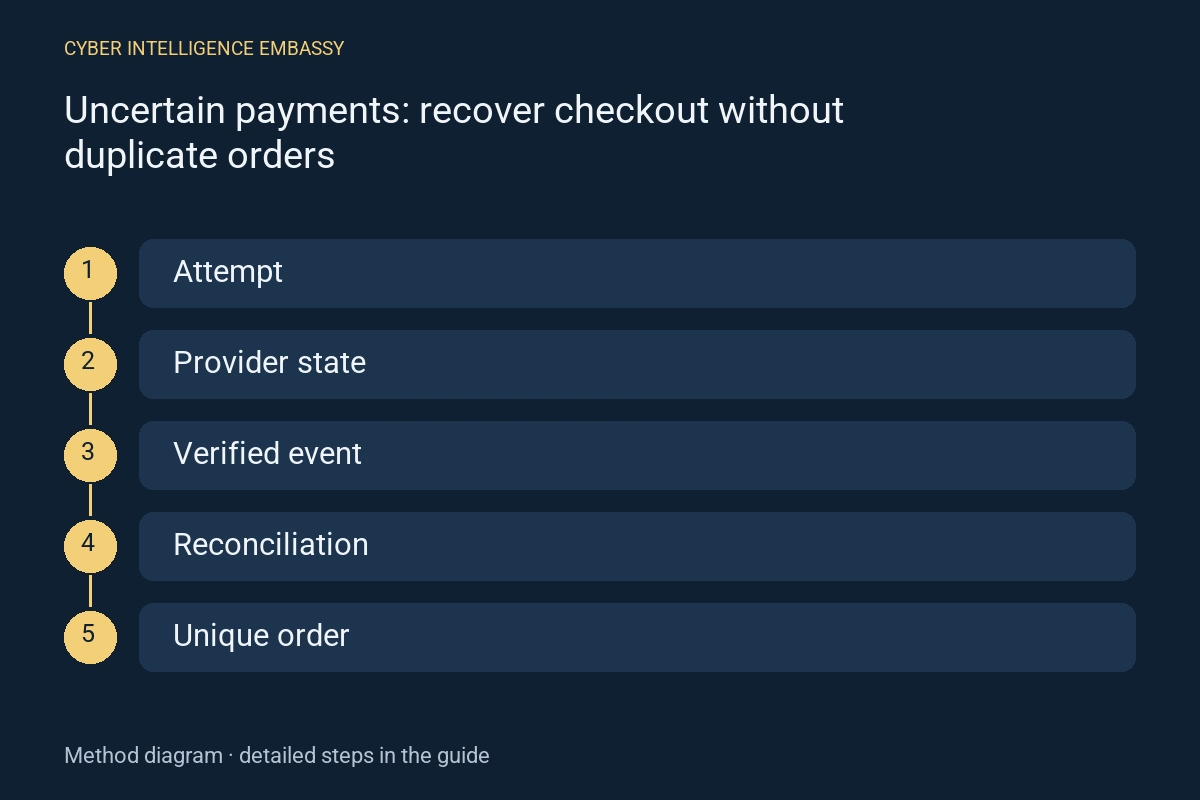
What this guide helps achieve
- Separate attempt, payment and order
- Handle delayed or missing returns
- Deduplicate notifications and requests
- Explain uncertainty without asking users to pay again
Quick check
- Which source confirms payment?
- Does closing the browser change business state?
- Does a repeated event prepare two orders?
- Are event signatures checked?
- How does support find an uncertain operation?
Step-by-step method
- 01
Define the states
Separate cart, attempt, authorisation, confirmed payment, order and refund. Write transitions, authoritative source and permitted actions. Follow the actual provider and payment methods; not every method confirms immediately.
Deliverable: state diagram and business contract.
- 02
Identify the operation
Connect an attempt to an order and provider identifiers. Use the documented idempotency rule for repetition of the same operation. A new purpose or changed parameters needs an explicit decision rather than blind key reuse.
Deliverable: stable identity and recovery rules.
- 03
Handle the browser return
Display state from a server-side check appropriate to the provider. A redirect to a success page alone is not payment evidence. Cover a closed browser, missing return, interrupted authentication and slow network.
Deliverable: return journey and messages by state.
- 04
Verify notifications
Check authenticity according to provider documentation, record event identity and handle repeats without duplicate effects. Events can be late or out of order. Where needed, retrieve the reference object before an irreversible transition.
Deliverable: tested handler and bank-data-free traces.
- 05
Reconcile discrepancies
Compare provider operations, orders and fulfilment. Isolate paid-without-order, order-without-confirmation, double processing and unpropagated refunds. Give each discrepancy an owner and procedure; do not automatically repeat an uncertain charge.
Deliverable: reconciliation queue and decisions.
- 06
Test complete recovery
In the provider’s test mode, replay timeout, duplicate, delayed event, reversed order and missing return. Check one business transition, correct customer information and support visibility. Idempotency details differ between providers.
Deliverable: non-duplication evidence and deployment criteria.
Worked example
Illustrative situation
Illustrative situation: payment succeeds, but the customer loses connection before confirmation and two notifications arrive later.
Decision and expected evidence
One order is confirmed. Recovery displays verified state, and support can reconcile the reference without requesting bank details.
Distinguish the mechanisms
| Mechanism | Purpose | Check or limitation |
|---|---|---|
| Browser return | Inform and resume the interface | Can be missing or interrupted |
| Verified webhook | Receive a provider state change | Can be repeated, delayed or out of order |
| Server reconciliation | Compare payment and order state | Needs a discrepancy-resolution rule |
Management indicators
| Indicator | What it measures | First action |
|---|---|---|
| Uncertain states | Operations unresolved within the intended delay | Check the reference state |
| Duplicate effects | Orders or processing performed twice | Fix business deduplication |
| Closed gaps | Reconciled cases with decision and evidence | Handle oldest and critical cases |
Common pitfalls
- Confirming from a success URL alone
- Treating timeout as payment failure
- Assuming events arrive in order
- Repeating a charge before checking
Frequently asked questions
Does a timeout mean failure?
No. It means the response was not received within the delay. Check the operation’s state before creating another.
Is provider idempotency sufficient?
No. Order creation, fulfilment and notifications must also tolerate repeated processing without duplicated business effects.
What should the user be told?
Explain that verification is ongoing, provide a safe reference and a way to retrieve status. Avoid requesting another payment while the previous one is uncertain.
Official references
Continue exploring