Resources · 48
Editorial media: provenance, alternatives and useful integration
Choose between photographs, illustrations and diagrams, disclose their status and communicate beyond pixels.
· 3 min
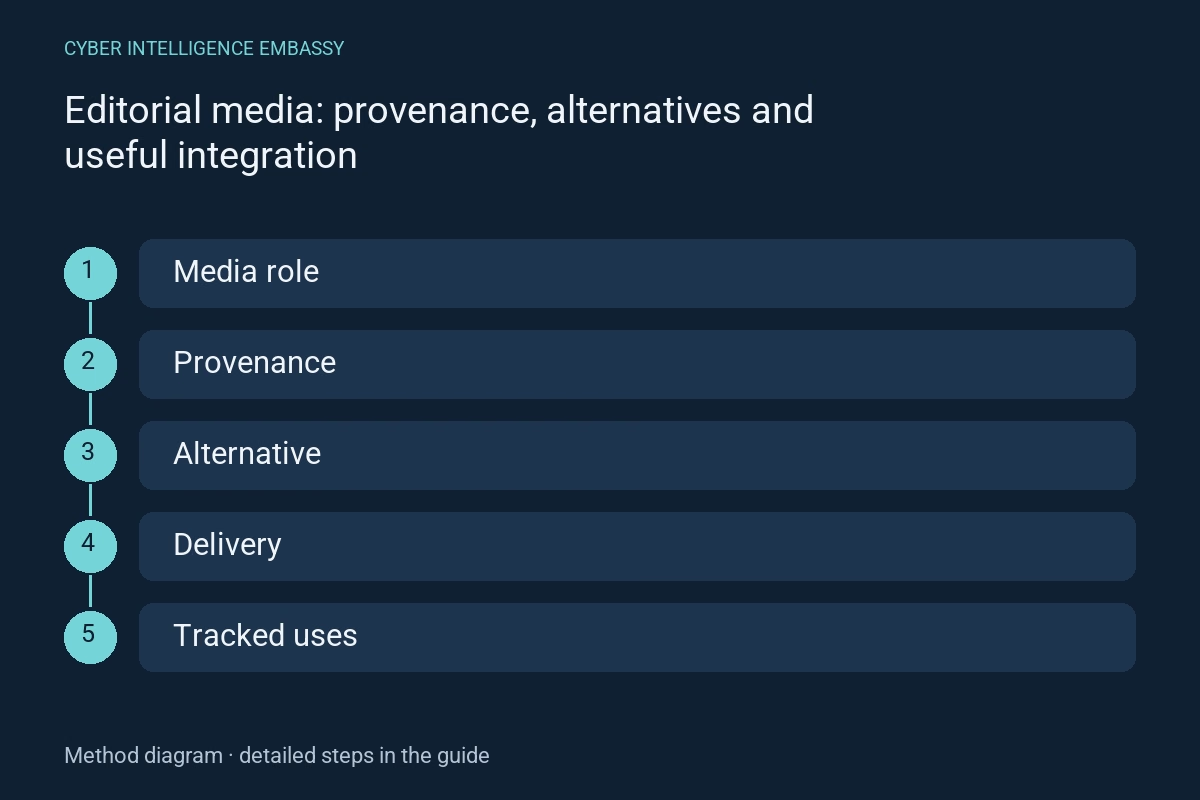
What this guide helps achieve
- Avoid presenting fictional scenes as evidence
- Describe the image’s function
- Explain diagrams in text
- Reduce weight without losing information
Quick check
- Does the image illustrate or document a fact?
- Are origin and use conditions known?
- Does a logo match the intended entity and version?
- Is the information also available as text?
- Do mobile variants remain readable?
Step-by-step method
- 01
Classify the media role
Separate documentary evidence, illustration, diagram, decoration and functional image. A realistic generated visual must not imply a real client, team or documented event. Prefer a diagram when the value lies in a relationship or method.
Deliverable: role, status and purpose for each asset.
- 02
Retain provenance
Record source, known creator, use conditions, date, transformations and consuming pages. For a logo, verify the official asset and intended context. Clearly disclose synthetic illustrations; invisible metadata alone does not inform the reader.
Deliverable: source register and visible information.
- 03
Write the appropriate alternative
Apply WAI’s role-based logic: brief descriptions for simple information, empty alternatives for redundant decoration, and destination or action for functional images. Avoid keyword lists or repeating a title without communicating the function.
Deliverable: alternatives reviewed in context.
- 04
Explain complex images
Place a list, table or description near a diagram with relationships, units and limitations. Alt text identifies the diagram; adjacent content conveys detail. A coloured map must not be the only place a conclusion appears.
Deliverable: verifiable textual equivalent.
- 05
Optimise delivery
Set dimensions, suitable variants and compression after visual review. Reserve image space and prioritise the image that opens the journey; load secondary media progressively. Check logo sharpness, transparency, crop and readability at small sizes.
Deliverable: optimised files and mobile test.
- 06
Check publication and maintenance
Verify served files, stable URLs, visible text, consistent markup, sharing and broken resources. Compare structured data with captions. After replacement, update affected pages and provenance instead of changing only the filename.
Deliverable: publication check and usage list.
Worked example
Illustrative situation
Illustrative situation: an advisory page uses an unlabelled synthetic meeting scene and a diagram whose details exist only inside the image.
Decision and expected evidence
The scene receives an explicit fictional-illustration label; the diagram’s steps are published as text with brief contextual alt text.
Distinguish the mechanisms
| Mechanism | Purpose | Check or limitation |
|---|---|---|
| Documentary photograph | Show a real fact or object | Verifiable origin and context |
| Synthetic illustration | Represent an idea | Explicit fictional status |
| Method diagram | Explain relationships and decisions | Text equivalent and limitations |
Management indicators
| Indicator | What it measures | First action |
|---|---|---|
| Traceability | Media with a known origin | Qualify untracked files |
| Useful alternatives | Images with role-appropriate text | Review on the actual page |
| Delivered weight | Bytes received by device and placement | Adjust variants and compression |
Common pitfalls
- Presenting an AI illustration as a team photograph
- Using alt text as a keyword list
- Giving only a title for a complex chart
- Compressing a logo until unreadable
Frequently asked questions
Does every image need descriptive alt text?
Treat images according to role. Redundant decoration can use empty alt; a functional image should convey its destination or action.
Can generated illustrations be used?
Yes when they add value and their status is clear. They must not replace evidence of a fact or imitate documentary photographs without explanation.
Should every image be lazy loaded?
No. The immediately visible primary image may need priority loading. Check the journey and actual measurements.
Official references
Continue exploring